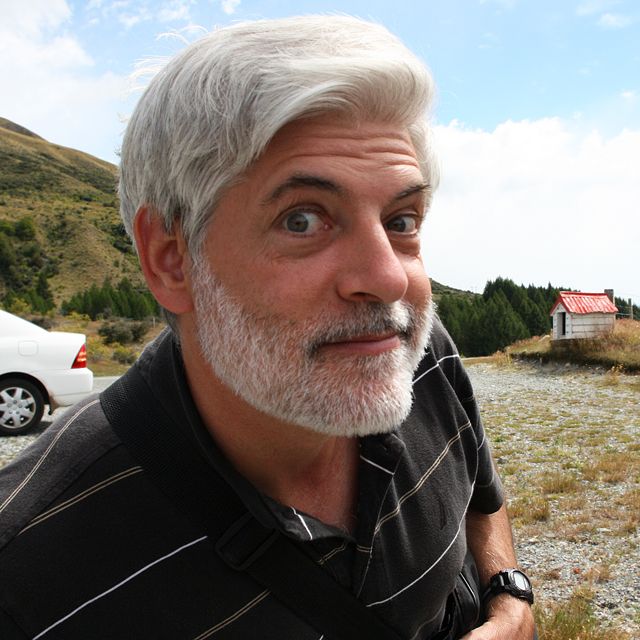
Hello! My name is R. Philip Bouchard. I spent most of my career creating computer applications – 18 years in educational software, then 14 years in web-based business-to-consumer apps. My best-known educational software games are “The Oregon Trail” (1985) and “Number Munchers” (1986). More recently, I’ve published an entertaining science book entitled “The Stickler’s Guide to Science in the Age of Misinformation”. I’ve also written an extensive series of educational essays, mostly focusing on science topics. You can find more information on my website:
https://philipbouchard.com/
TGN: Where were you born, and where did you grow up?
RPB: I was born in Atlanta, Georgia, and I grew up in Cobb County, Georgia, near Marietta. Later I lived in North Carolina, Texas, Colombia, Minnesota, California, Australia, and Virginia. Now I’m back in Georgia, where I live with my wife.
TGN: What types of games did you play in your childhood?
RPB: When I think of “playing games”
as a kid, I first think about the many unstructured outdoor activities we did – because we kids spent much of our time outside. So on any given day, we might play hide and seek, or build a fort, or explore the woods, etc. When we sat down at a table to play a game, it was usually a card game, using an ordinary deck of cards. However, I remember enjoying the game “Mille Borne”, and occasionally playing “Monopoly”. As a teen, I would sometimes play backgammon or chess. My favorite card games were Spades, Casino, and Oh Pshaw.
TGN: When did you first become interested in designing games?
RPB: By the time I graduated from the University of Georgia in 1976 with a degree in botany, I already had experience writing computer programs in several programming languages. I wondered if computers might rival film as an important educational technology in the near future – even though personal computers did not yet exist. I spent the next 3 years studying two distinct subjects in grad school – computer science and natural science – while creating fun little computer simulations to help students understand key natural science concepts. I received my master’s degree from the University of Texas in 1979, but I was a bit premature – no one was yet hiring professionals to create educational computer software. But in 1981 the nascent industry was finally getting off the ground, and I was able to find a job at MECC in Minnesota. At MECC, my primary interest was to create highly immersive, entertaining experiences that were also educational.
TGN: What was your first game related job?
RPB: My first full-time game-related job was when I joined the staff of MECC (Minnesota Educational Computing Consortium) in May 1981. By that time I was 27 years old. MECC’s focus was education – not games – but some of the computer activities could be quite entertaining. My goal was to create products that were highly entertaining AND genuinely educational.
TGN: When and how did you become an employee at MECC?
RPB: I first read about MECC in 1979 and found it intriguing that they were converting their educational software to run on Apple II computers. Previously, everything had been written to run on their mainframe computer. However, when I began my job search in 1980, I first targeted universities across the eastern U.S. I personally visited many universities, but everyone told me the same story: No one in 1980 employed full-time professionals to create educational computer software. However, I was twice told that I ought to look into MECC. Therefore I wrote a letter to MECC in November, but I did not hear back from them. Finally, early in 1981, I accepted a job at the Emory University computation center as a computer programmer – creating graphing applications rather than educational software. MECC finally responded to my inquiry, indicating that they were very interested. I soon moved to Minnesota to become MECC’s first full-time Apple II programmer, while also supervising a dozen part-time student programmers.
TGN: Was anyone who worked on the original 1971 version of Oregon Trail involved in the making of the 1985 version?
RPB: Don Rawitsch, who initiated the concept for the 1971 version, was on the MECC staff in a management position throughout the 1980s. However, his department focused on teacher training – not software creation – so he declined my offer to serve as an advisor to my team. (He felt it would be inappropriate to become involved.) This was not a problem, because my mandate allowed me to rethink every aspect of the original concept – provided that I did not lose the “magic” that made the original so popular.
TGN: What was your favorite feature you designed in The Oregon Trail?
RPB: My favorite detail in the 1985 version is the animation of an ox pulling a wagon across a sliding background – although this feature was conceived by other team members, not me. I really like the hunting module, and I really like the river crossing module – both of which required a lot of research and simulation modeling on my part. On a more subtle level, I really like that the player names the members of the traveling party – whose fates are tracked individually by the simulation engine. I like that the game is sufficiently balanced to allow players with different interests and strategies to succeed – but only by playing several times to improve and refine those strategies. I like that the game is full of features that encourage replay, thereby providing players with incentives to play over and over again. And I am very proud of the complex, interlocking mathematical engines that drive the many simulation components, including weather, health, river crossings, travel progress, supplies, and so on.
TGN: When did you first realize your version of The Oregon Trail had become a hit?
RPB: We released the product in August 1985, but initially for the home market only. At our annual teacher conference in November that year, the attendees loved the game, but were furious that there was not a school edition, and that the product was not included in our school site licensing program. We soon released a school edition (same software, but with lesson plans and teacher support material) and then eventually included it in the site license program. It soon became exceedingly popular in schools throughout North America, which helped drive sales of the home version. By the spring of 1986, the product had clearly become a major hit. However, I expected the product to fade away after perhaps five years. For me, the surprise is not that the product became quite successful, but that people still talk about it 40 years later.
TGN: What other games did you design, and which are your favorites?
RPB: Other than “Oregon Trail”, my most famous game is “Number Munchers” (in collaboration with Steve Taffee). These two products became the cornerstones of MECC’s fame and its value when it was sold to private investors and later resold. Of the products I designed and built during my freelance years after leaving MECC, my favorites are “Lewis & Clark Stayed Home”, “Dr. Livingstone, I Presume?”, and “Checkerboard Trails”. However, none of these are as much fun as “Oregon Trail” or “Number Munchers”. In recent years, after my retirement from computer software design, I created an entertaining board game about rare earth minerals. However, I chose not to go through the trouble of publishing it.
TGN: You have interests in natural science and nature in general, do you have any nature-related hobbies?
RPB: Oh yes, I have several hobbies related to the natural sciences, including:
· Identifying and photographing wildflowers (in Georgia, California, Australia, and many other places) – See https://flickr.com/photos/pbouchard/albums.
· Gardening, including an eclectic mix of native plants and cultivated varieties, many of which are unfamiliar to a typical homeowner or landscaper.
· Leading hiking trips with the Georgia Botanical Society to see wildflowers and other plants in their native habitats.
· Writing educational essays about various topics in the natural sciences.
· Finding rocks that are good for polishing, then polishing them in my rock tumblers.
· Reading books on the natural sciences (and writing one too).
· Studying the natural details of locations all over the world, mostly from the comfort of my own office, but sometimes by visiting in person.
Be sure to check out his book ‘You Have Died of Dysentery’ on Amazon!
 TheGameNarrative