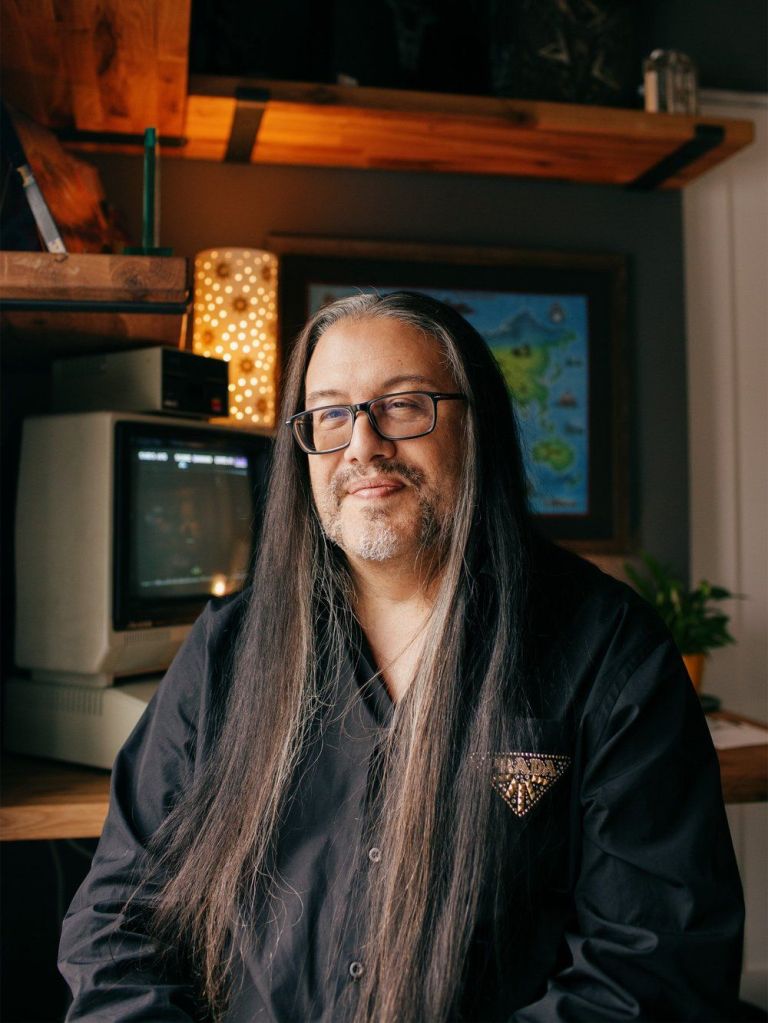
John Romero is one of the pioneers of the video game industry and a co-founder of id Software, where he helped create some of the most influential games of all time, including DOOM, DOOM II, Wolfenstein 3D, and Quake. With a career spanning more than four decades, he has worked across nearly every era of game development, from early Apple II programming and shareware games to MMOs, mobile games, and modern first-person shooters.
Known for his focus on innovation, game design, and pushing technology forward, John has created dozens of games and continues to make games with his studio, Romero Games. He is also the author of Doom Guy: Life in First Person, a memoir covering his journey from a young programmer discovering computers to becoming one of the defining figures in the history of video games.
In this interview, John shares stories about his early influences, favorite games, technology, music, movies, creative process, and the experiences that shaped his life in game development.
TGN: Before having access to the mainframe at Sierra College and arcades, what types of games did you play in your childhood?
JR: I played the popular board games you’d expect—Parcheesi, Monopoly, checkers, chess, and Life—and card games like poker, Uno, and Go Fish. But honestly, I was much more interested in building things. I loved Tinkertoys, Lincoln Logs, and especially my Erector Set. I liked figuring out how things fit together and making something of my own.
Then in sixth grade I took an electronics class, and that really grabbed me. Learning about circuits and how electronic components worked was fascinating. Looking back, I think I was already more interested in systems and construction than in simply playing games. Games became much more interesting to me once computers entered the picture, because suddenly I could build the systems myself.
TGN: What were the first games that you created using the terminal at Sierra College?
JR: The first game I created on the terminal at Sierra College was a very simple adventure game. You moved from room to room, and each room had a different environment and objects to discover. It was completely influenced by Adventure, which I had been playing along with other mainframe games like Poison Cookie, Nim, and Hunt the Wumpus.
What fascinated me about Adventure was the idea that you could build a world entirely out of text. Even with no graphics, the player could explore a place, understand where they were, and interact with things. My first game was really me trying to understand how that worked by making my own little world.
TGN: What was your favorite arcade game during your youth?
JR: Absolutely Pac-Man. It was only the second color arcade game after Galaxian, and at the time it looked incredible. The color alone made a huge impression, but the sound was just as important. It had a new sound chip, and Pac-Man really showed it off with music and sounds that gave the game a personality arcade games hadn’t really had before.
I became completely obsessed with mastering it. I worked out my own patterns for each level and practiced them over and over. I got to the point where I could play the first two levels without even looking at the screen because I knew the timing and movements so well.
Pac-Man had everything I loved: a simple idea, immediately understandable rules, great audiovisual feedback, and enormous depth once you decided you wanted to master it.
TGN: When you were attending high school on the Royal Air Force base in England, and writing programs for the Aggressor Squadron that was stationed there, what type of programs did you write and was the coolest thing that you saw on base?
JR: The main program I wrote for the Aggressor Squadron was a combat resolution questionnaire. It kept track of the pilots’ answers after training engagements and could display all of those responses whenever they were needed. It also performed calculations on the numerical data so the results could be reviewed and analyzed by the people running the exercises.
That was probably the first time I wrote software that was being used for a real operational purpose instead of just for myself. I was still in high school, so having something I wrote actually help people analyze pilot performance was pretty exciting.
The coolest part was working right next to the flight line. I’d see F-5s taking off and landing, and the sound would shake all the windows around me. I also saw the TR-1 take off at an incredibly steep angle, almost vertically. Being that close to those aircraft in operation was unforgettable.
TGN: What was your favorite early game that you created at SoftDisk and magazines such as UpTime?
(I have always wanted to play The Pyramids of Egypt, myself!)
JR: My two favorites were Pyramids of Egypt and Dangerous Dave. I’d say they were equally exciting for me to make and to play, and they were also the biggest games I had made up to that point.
Dangerous Dave had 10 levels, with each one becoming more intricate and difficult as you progressed. Pyramids of Egypt was much larger, with 100 levels, and the cobras could behave in wildly unpredictable ways, which kept the game feeling dangerous and surprising.
Both games felt like a real step forward for me. They were larger, more ambitious, and gave me much more room to think about level design, difficulty progression, and how to keep a player engaged over a longer game.
TGN: What are the names of some of your other early games? (Including any that were never published)
JR: That would be a very long list. I have around 40 unreleased games from those early years, ranging from half-finished experiments to games that were nearly complete but never published.
Some of the early published games include Krazy Kobra, Scout Search, Bongo’s Bash, Lethal Labyrinth, Evil Eye, Jumpster, Neptune’s Nasties, Major Mayhem, City Centurian, Cavern Crusader, Phantasm III, Twilight Treasures, and Sub Stalker.
Then there are a lot of unreleased games: Alien Attack 1 through 4, Relic Quest, Trashman, Snag!, Radical Reptiles, Phantasm I and II, The Unknown, Mystery Mountain, Dodge ’Em, Enemy Attack, Tower Toppler, and many more.
I was making games constantly during that period. A lot of them were experiments with new ideas, new mechanics, or simply attempts to see if I could make something work. Even the unfinished ones were important because I was always learning something from them.
TGN: You co-created the game Gunman Taco Truck with your step-son Donovan. What is your favorite style of taco to eat, in the real world?
JR: My favorite taco is what’s known as a patty taco. It’s basically a Mexican hamburger in taco form: a seasoned hamburger patty inside a tortilla, then fried crisp in the dorado style.
I grew up eating them, so that’s always been the style of taco I think of first. Crispy on the outside, juicy on the inside, simple, and still my favorite.
TGN: It is known that John Carmack ate a lot of pizza while programming during the id Software era. Did you have a favorite food for your long work sessions? Do you have one currently?
JR: We all pretty much ate the same thing because we were always together—breakfast, lunch, and dinner. We lived our work. There wasn’t really a distinction between going to work and the rest of the day. We were making games constantly.
Pizza was definitely popular because we could just order it and keep working instead of spending time cooking. But we also went out to eat at various restaurants. Rancho La Sandia in Mesquite was one of our favorites.
I don’t think I ever had one particular food that was my personal fuel for long programming sessions. The important thing back then was that eating didn’t interrupt what we were doing. We were completely absorbed in making the games.
TGN: As a fan of music, do you play any music instruments or have you ever tried to learning one?
JR: In 1989 I spent some time playing guitar and learning a little. I enjoyed it, but I quickly realized that getting better at guitar required a lot of time—and that was time I wasn’t spending making games.
Games were already completely consuming me, so eventually the guitar got put away. I’ve always loved music, but creating games was the thing I wanted to devote my time to.
TGN: Are there any specific things or objects from the 80’s that you have a lot of nostalgia for?
JR: I have nostalgia for a lot of things from both the ’70s and ’80s. The Rubik’s Cube is a big one—I completely mastered it. I remember my wrist radio, my Erector Set, Mattel Football, BMX bikes, building forts, sleepovers, and playing Odyssey 2 games. I also loved board games like Dark Tower and Stop Thief.
But a lot of the nostalgia is really about the atmosphere of the time. Dark arcades packed with kids, arcade tournaments, drive-in movies, and hearing some incredible new song come over the radio for the first time. Music was constantly surprising me, whether it was rock, metal, new wave, or pop—songs like “Children of the Sun,” “Straight On,” “Dazed and Confused,” “The Promise,” “Smalltown Boy,” “Hunting High and Low,” “Rime of the Ancient Mariner,” “Lay Your Hands on Me,” “Hold Me Now,” “Love My Way,” and so many others.
It was a great period for discovering things. New games, new gadgets, new music—there always seemed to be something showing up that felt completely different from what had come before.
TGN: What is your favorite programming language, and least favorite programming language, that you have used.
JR: For years, I loved living in 6502 assembly. It was such a fun language to work in, and at the time it was critically important for making games with fluid motion and getting everything possible out of the hardware. You were very close to the machine, and there was something really satisfying about that.
These days, I don’t need that level of low-level control, so Lua is probably my favorite. It’s compact, clean, and incredibly functional. You can get a lot done with very little code, which I really appreciate.
My least favorite is Perl. Barf.
TGN: Favorite computer you have ever used?
JR: I’d have to say the Mac. I’ve used Macs for decades, and I’ve always appreciated how well the hardware and software work together.
Very close behind it would be NeXTSTEP. It was incredibly advanced for its time and had a huge influence on what came later.
And the Apple //e will always be very dear to my heart. I spent years programming it, especially in 6502 assembly, and it was such an important machine in my development as a programmer and game designer.
TGN: Out of every game you have created, which one has your favorite box art?
JR: I’d have to say either the Beast Box cover for SIGIL or the cover of SIGIL II. Both of those are incredible pieces of artwork and really capture the spirit of those games.
After those, I’d put DOOM II and then DOOM. Those covers are iconic and represent such an important era of my career. The artwork wasn’t just packaging—it was the first impression players had of the world they were about to enter.
I’ve always loved when the visual identity of a game feels as strong as the game itself, and those covers really achieved that.
TGN: What was the most difficult hardware you have ever had to work with, while writing programs or designing?
JR: Definitely writing page-flipping graphics code for the Apple //e’s double hi-res video mode. It was incredibly complex, and probably second only to the Atari 2600 in terms of challenging hardware to program.
The Apple //e double hi-res mode had a particularly difficult memory layout. The pixel data was stored across two separate memory banks, and a single pixel could actually have bits spread between both banks. To draw and animate graphics efficiently, you had to understand exactly how the video hardware was fetching and combining that data. Page flipping added another layer of complexity because you were managing multiple screens in memory to create smooth animation.
You weren’t just drawing graphics—you were carefully managing memory, timing, and display behavior to squeeze out smooth animation from very limited hardware. It was a great learning experience because you had to understand exactly how the machine worked.
TGN: I have heard a couple of different versions of the id Software name origin. “Ideas From the Deep” and “In Demand” being the two that it is a reference to. Can you shed some light on this?
JR: Both of those stories are actually connected. Before id Software officially existed, we were a small group at Softdisk that called ourselves Ideas from the Deep. The name was shortened to IFD, and later, when we formed the company, we dropped the “F” and became id.
At the same time, “In Demand” was another meaning that fit the name. We liked the idea that “id” was short, memorable, and had a feeling behind it. It worked as a connection to our earlier name, but it also described what we wanted to be—creating things people wanted.
So the answer is that both references existed. “Ideas from the Deep” was the original source, and “In Demand” became another interpretation that made sense as we were building the company. Eventually, id became its own identity rather than just an abbreviation.
TGN: What was the most challenging part for you, writing ‘Doom Guy’?
JR: The most challenging part of writing Doom Guy was figuring out which stories were the most important to include. I have hyperthymesia, so I remember an enormous amount of detail, and the difficult part was that everything feels connected. Every event leads to another event, and every story has some relationship to the larger journey.
Another challenge was reconstructing the timeline, especially around 1991. There were so many things happening at once—multiple games being developed, major technical breakthroughs, company changes, and personal events all overlapping. Doing the mental gymnastics to make sure the timing of everything was accurate was a huge undertaking.
After the writing was complete, the next challenge was cutting it down to fit the required page count. I had to remove around 30,000 words, which was extremely difficult because those were all stories that mattered to me. The challenge became finding the core of the story—keeping the moments that best explained the journey while making sure the book remained focused and engaging for readers.
TGN: What is your favorite word or phrase to say in Irish (Gaeilge)?
JR: Go raibh míle maith agat! It means “thank you very much,” and it’s probably my favorite Irish phrase.
I love how it sounds when spoken. Living in Ireland has given me a much deeper appreciation for the language and the culture around it. Even a simple phrase like that carries a lot of warmth and connection, which is so Irish.
TGN: Out of all the items from your past, in your archives, which is your most treasured?
JR: That’s really tough to decide because I’ve kept so much of my stuff from when I was a kid.
If I had to choose, I’d probably say my early source code and notebooks are the most important to me. They’re a direct record of how I was thinking at the time—ideas, experiments, game designs, code, problems I was trying to solve, and the progression of my skills as I was learning.
A lot of those things were never meant to be historical documents. They were just what I was working on every day. Looking back at them now, they capture the process of becoming a game developer in a way that finished games alone really can’t.
TGN: Have you ever lost an object from your past, or anything that was destroyed, that you wish you still had to add to your archives?
JR: Yes. One thing I really wish I still had is an early orange-castle version of Akalabeth. That disappeared somewhere along the way, and I’d love to have it in the archive now.
The biggest loss, though, was an entire set of about 30 disks containing source code and other development material from 1989 and earlier. I still have all the games I made, but I don’t have all of the original source code because of that loss.
That’s the part I regret most, because source code is such a direct record of how you thought and worked at the time. The finished games survived, but some of the history behind how they were actually built is gone.
TGN: I know you enjoy your Mini, but do you ever miss your Ferrari? Would you ever want to own another supercar?
JR: I definitely miss some of the cars I’ve had. I loved my Ferrari 348 and Testarossa, and I really enjoyed my BMW 840Ci too. But I also loved my H1 Hummers just as much. They were completely different experiences, but all of them were fun in their own way.
The Mini is perfect for the roads in Ireland, so it makes a lot of sense for where I live now. It’s small, quick, and easy to live with.
Would I own another supercar? Absolutely, if the right one came along. But I’m also very interested in what’s happening with EVs right now, and I’m looking at getting a new one. At this point I’m less interested in owning something just because it’s exotic and more interested in whether it’s genuinely fun, interesting, and great to drive.
TGN: Do you currently have any hobbies that do not involve games?
JR: Not really. I don’t have anything that takes up my spare time that I would consider a separate hobby. Games are pretty much everything I do.
Making games, playing games, studying games, thinking about design, programming, researching old games—it all overlaps for me. I’ve never really felt the need to have a hobby to get away from games, because games are the thing I genuinely want to spend my time doing.
TGN: What is your go-to/favorite weapon type to use, in any FPS?
JR: My favorite weapons in an FPS are sniper rifles and shotguns, probably equally. I love the precision and patience of a good sniper rifle, but I also love the immediacy and impact of a great shotgun.
After those, rocket launchers are probably next. They’re just incredibly satisfying when the movement, timing, splash damage, and level geometry all come together.
Those three weapon types cover a lot of what I enjoy most in FPS combat: precision, power, timing, and making every shot count.
TGN: Favorite book?
JR: That’s incredibly difficult because I read a lot, especially science fiction, which is my favorite genre.
I’ve probably loved Dan Simmons’ books the most over the years—the Hyperion series, Ilium and Olympos, The Terror, and many others.
So if I have to pick just one, I’ll say Hyperion. It has everything I love about great science fiction: huge ideas, mystery, incredible worldbuilding, memorable characters, and a story that keeps opening up into something much bigger than you first expect.
TGN: Favorite film?
JR: That’s another really difficult one because I love so many different kinds of movies.
If I go by the films I’ve kept loaded on my phone so I can always watch them, there are a lot of Marvel movies, the John Wick films, Interstellar, and several others.
But if I have to choose one, I’m going with Interstellar. It has the scale and ideas I love in science fiction, but it’s also very emotional and human. It’s one of those movies I can keep coming back to.
TGN: You played a major role in creating the remake of Castle Wolfenstein (Wolfenstein 3D)…Since living in Ireland, have you visited any castles?
JR: Absolutely. Living in Ireland, I’ve had the opportunity to visit a lot of castles and historic ruins. I’ve visited Blarney Castle, Bunratty Castle, Kilkenny Castle, and many others, along with countless abbey ruins throughout the country.
One of the most memorable experiences was actually sleeping overnight in Leap Castle. Being inside a centuries-old castle at night is an incredible experience, especially with all of the history and stories surrounding these places.
I’ve always loved castles, so living in Ireland feels like being surrounded by the kind of environments that inspired games like Wolfenstein 3D. There’s history everywhere you look.
TGN: Any time you started a new company, did you approach it as a fresh start, or did it feel more like a continuation of the last one, a rebrand with new people involved?
JR: Every new company was a fresh start for me. I always approached it as a new mission, not as a continuation of the previous company or a rebrand with a different name.
Each company had its own purpose and its own challenges. Whether we were making MMOs, social games, mobile games, FPS games, or something completely different, I wanted to focus on what that new team and that new group of people could create.
The common thread was always the desire to build something new and push into areas I hadn’t explored before. The technology, the genre, and the team might change, but the excitement of creating something from nothing was always the same.
TGN: Who is your favorite character from Star Wars? …And if you could own any object from the Star Wars universe, what would it be?
JR: My favorite character from Star Wars would be Emperor Palpatine. He’s such an iconic villain because he represents the ultimate use of power, manipulation, and patience. He’s not just physically dangerous—he’s dangerous because he understands people and knows how to control events from behind the scenes.
If I could own any object from the Star Wars universe, it would be a lightsaber. It’s probably the most recognizable and personal object in that universe. It’s both a weapon and a symbol, and the idea of having one is just incredibly cool.
TGN: If you could meet anyone in the game industry you have not yet met, who would it be?
JR: That’s a really difficult question because there are so many people in the game industry I’d love to spend time with.
In Japan, I’d love to sit down and have a real conversation with people like Shigeru Miyamoto, Yasunori Mitsuda, Hironobu Sakaguchi, Yu Suzuki, Fumito Ueda, Keiichiro Toyama, and Nobuo Uematsu. I’ve met some of them in person, but it’s a very different experience when you can speak fluently in someone’s native language and really have a deep conversation.
In the West, I’ve always enjoyed spending time with people like Ron Gilbert and Tim Schafer. They’re funny, they have incredible stories, and they’re great storytellers. I worked with Ron for a year, and swapping stories about the ’80s and talking about Monkey Island was a blast.
The best conversations in this industry are usually the ones where people can go deep into how they created things, the challenges they faced, and the moments that shaped their careers.
TGN: If (reverse) time travel were possible, and you could play a deathmatch in Doom against anyone from history, who would you want that person to be?
JR: I’d love to play some more DOOM II with NoSkill. We had some great deathmatches, and it would be fun to go back and play again with all the experience and memories from that era.
There are a lot of people from history I could choose, but for me, the best answer is someone who would actually be fun to play against. Deathmatch is about the competition, the trash talk, and the shared experience as much as the game itself.
NoSkill was the best.
I want to thank John, very much, for this interview. I had the opportunity to chat with him via video-call in the past and it was one of the inspirations for me to start TheGameNarrative.